
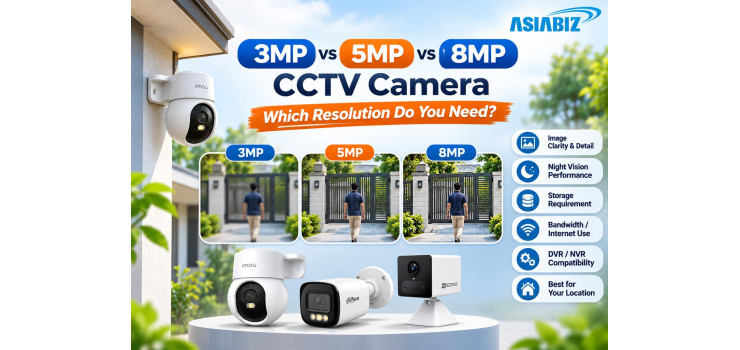
3MP vs 5MP vs 8MP CCTV Camera: Which Resolution Do You Need in Bangladesh?
When buying a CCTV camera for your home, shop, or office in Bangladesh,
you will often see 3MP, 5MP, and 8MP in product titles. Does an 8MP camera
automatically provide better security? Is 3MP enough for an apartment? And is
5MP worth the additional cost?
This 3MP vs 5MP vs 8MP CCTV camera guide explains the differences in
image detail, night vision, viewing distance, storage, internet use, and
installation cost so you can choose a resolution that fits your property.
Quick Answer: Which CCTV Resolution Should You Choose?
Choose 3MP for a small room or a clearly defined entrance; 5MP for
extra detail in homes and small businesses; and 8MP (4K) when you need more
image detail across a larger scene and have the storage and recording equipment
to support it.
These are starting points, not guarantees. Camera placement, lens
angle, sensor quality, lighting, and subject distance can matter as much as
resolution.
What Do 3MP, 5MP, and 8MP Actually Mean?
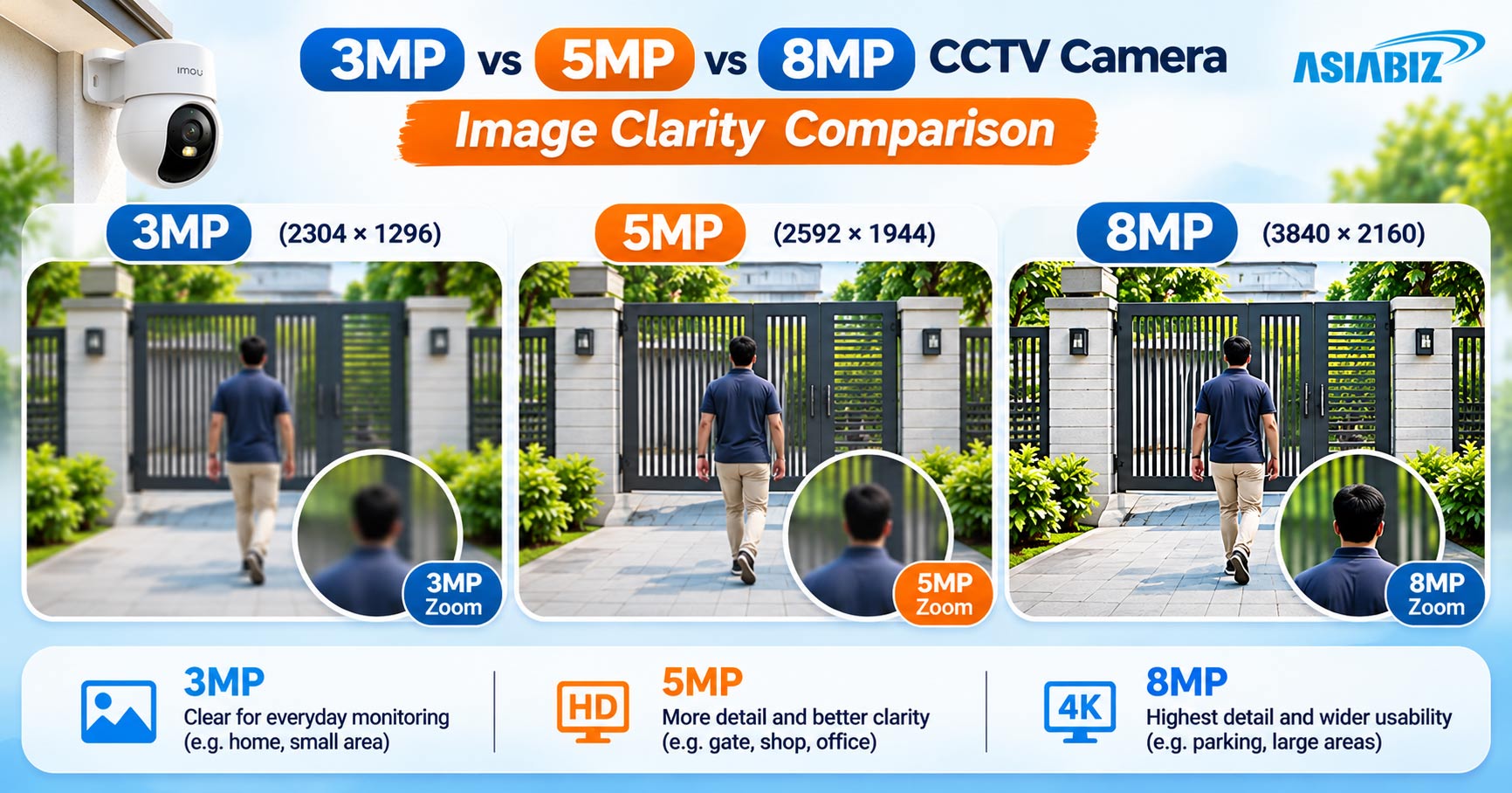
MP stands for megapixels: approximately one million picture elements in
an image. More pixels can preserve finer detail when the subject occupies
enough of the frame.
Different models use different image shapes and exact pixel counts. Common examples include:
|
Resolution
class |
Example
image dimensions |
Approximate
pixels |
Typical
benefit |
|
3MP |
2304 × 1296 |
3.0 million |
Everyday monitoring |
|
5MP |
2592 × 1944 or 2880 × 1620 |
About 4.7–5.0 million |
Additional detail for key areas |
|
8MP / 4K UHD |
3840 × 2160 |
8.3 million |
More pixels for a broad or detailed view |
The image aspect ratio also matters: a 4:3 camera may show more
vertical scene than a 16:9 model at a similar location. Always compare the
exact product's resolution and field of view.
3MP vs 5MP vs 8MP CCTV Camera: Key Differences
|
Buying
factor |
3MP |
5MP |
8MP |
|
Fine image detail |
Good for nearby subjects |
More room for detail |
Highest potential of these three |
|
Digital crop/zoom |
Limited |
More flexibility |
More flexibility if optics and lighting allow |
|
Typical use |
Bedrooms, small rooms, narrow entrances |
Home gates, shops, small offices |
Wider outdoor areas, detailed surveillance |
|
Storage requirement |
Often lowest |
Often moderate |
Often highest at comparable settings |
|
Network requirement |
Usually lighter |
Moderate |
Can be heavier |
|
Equipment cost |
Often budget-friendly |
Mid-range options |
Often higher overall system cost |
|
Night vision |
Model-dependent |
Model-dependent |
Model-dependent |
Important: Higher resolution
alone does not provide a wider viewing angle, longer IR range, improved AI
detection, or optical zoom.
1. Image Clarity, Zoom, and Identification
An 8MP image contains more pixels than a 3MP image. If two cameras have
comparable lenses, framing, lighting, and processing, the 8MP model may retain
more useful detail when you crop a recording.
But digital zoom only enlarges existing pixels. A distant person
occupying very little of the image may still be unrecognizable. A narrower,
properly aimed lens can be more valuable than extra megapixels.
For shop cash counters or building gates, test whether faces are clear
at the actual distance instead of judging only by the number printed on the
box.
2. Night Vision: Is 8MP Always Better?
No. A good 3MP or 5MP camera can outperform a weaker 8MP camera at
night. Low-light footage depends on sensor size, lens aperture, exposure time,
image processing, and illumination.
Traditional infrared (IR) night vision often records in black and white.
Smart dual-light cameras may switch between IR and warm visible light.
Full-color technologies can show useful color where lighting permits.
Check whether the camera handles moving people without excessive blur,
and whether streetlights or vehicle headlights create glare. Compare real night
footage recorded from the same distance if possible.
For more context, explore Dahua IP cameras with different night-vision
technologies.
3. Storage: How Much More Space Does 8MP Need?
Higher-resolution video can require more storage, but bitrate is the
main practical measure of video data. Frame rate, H.264 versus H.265
compression, scene movement, and continuous versus motion-based recording also
affect storage.
As a simple illustration, a camera recording continuously at 4 Mbps
produces roughly 43 GB per day before small overheads. At 2 Mbps, it produces
about 22 GB per day. These are bitrate examples—not fixed requirements for a
3MP, 5MP, or 8MP camera.
Before buying, check the supported microSD capacity or NVR hard-drive
size. For several cameras, calculate the total recording time you need, such as
7, 15, or 30 days.
4. WiFi Speed, Mobile Data, and Remote Viewing
An 8MP main stream may require more network bandwidth than a
lower-resolution stream at similar quality settings. Multiple high-resolution
cameras also place more load on a WiFi network or NVR.
Many cameras offer a lower-bitrate sub-stream for smartphone viewing,
while recording a clearer main stream locally. This can reduce bandwidth during
remote viewing. However, it does not eliminate internet use entirely.
For a 4G SIM camera, check the selected stream, mobile data allowance,
and how frequently you watch live video. For PoE systems, verify network and
recorder capacity.
5. DVR, NVR, and Monitor Compatibility
Not every recorder supports every camera resolution. Before upgrading
from 3MP or 5MP to 8MP, check the recorder's supported incoming resolutions,
maximum camera channels, total incoming bandwidth, decoding capacity, and
supported frame rate.
For analog HDCVI/TVI/AHD systems, the XVR must support the camera's
output format and resolution. Otherwise, you may see an unsupported or
invalid-format message. For IP systems, confirm ONVIF or manufacturer-specific
compatibility as well as PoE power requirements.
An 8MP camera also does not guarantee 4K display on every screen.
Playback quality depends on the recorder, output resolution, and monitor.
6. Which Resolution Fits Different Properties in Bangladesh?
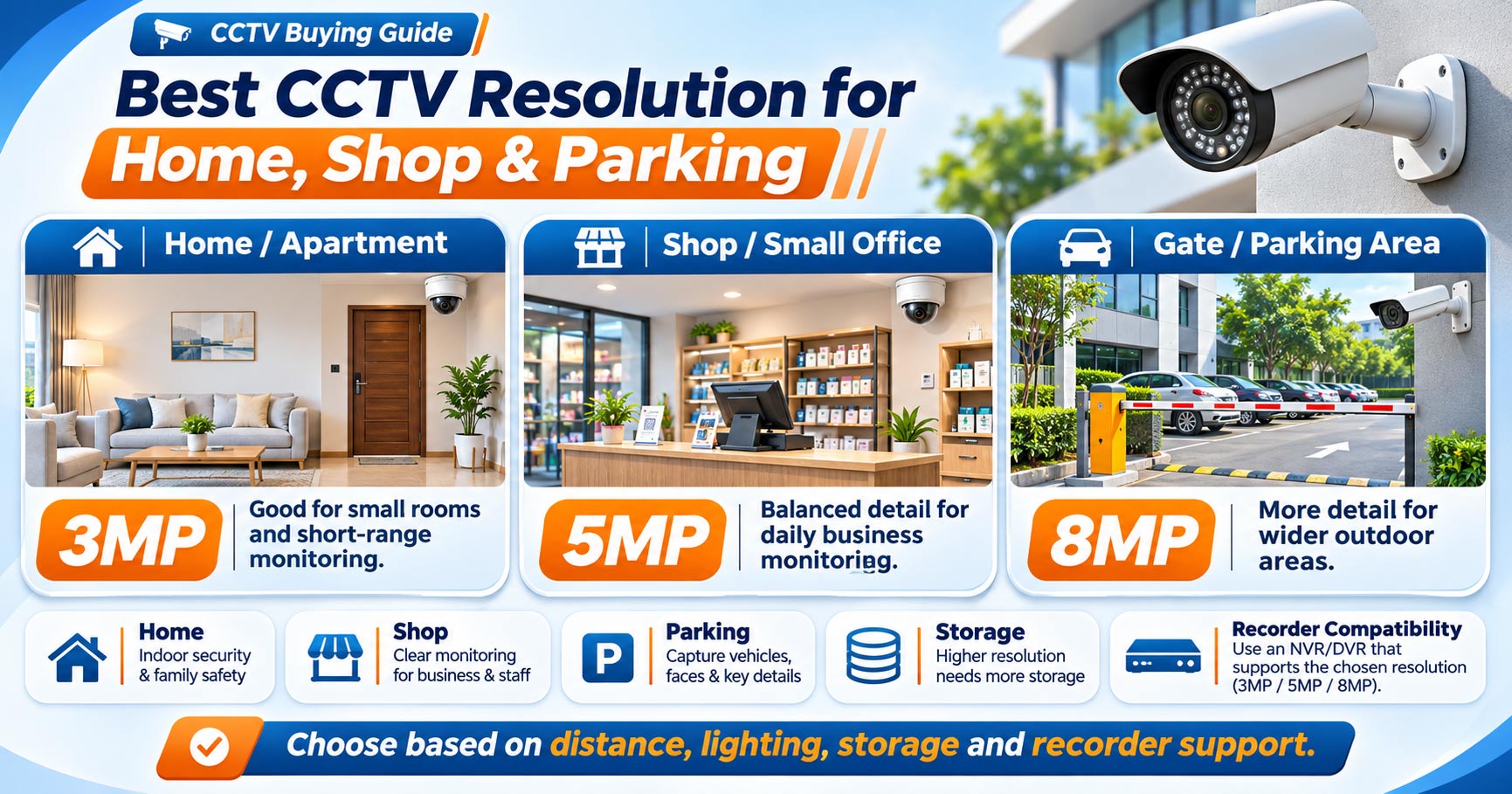
Apartment, Baby Room, or Small Living Room
A 3MP indoor WiFi camera may provide sufficient detail for checking
activity, pets, or visitors. Prioritize suitable camera placement, two-way
audio, and privacy settings if needed.
Home Entrance, Staircase, or Small Shop
A 5MP camera is a useful middle-ground choice when you want additional
detail without automatically moving to an 8MP setup. Check the width of the
entrance and distance to the people being recorded.
Large Shop, Parking Area, or Building Gate
An 8MP outdoor IP camera may help retain detail across a broader scene.
But for a large parking lot, two correctly positioned cameras may still work
better than one wide-angle 8MP camera.
Warehouse, Rooftop, or Multi-Storey Property
Plan camera locations before deciding on resolution. You may need a mix
of 3MP, 5MP, and 8MP models based on each area's purpose. Stable power,
storage, and reliable connectivity matter for all three.
Camera Examples Available at Asiabiz
These models illustrate different needs; they are not direct laboratory
comparisons. Confirm current prices, stock, warranty, and specifications before
purchasing.
3MP: Imou Ranger 2 Pro IPC-S2EP-3R1S
The Imou Ranger 2 Pro 3MP is an indoor WiFi camera listed with 2304 ×
1296 resolution, pan-and-tilt monitoring, two-way audio, and smart detection.
Consider it for family rooms and small apartments.
5MP: Imou Ranger 2 Pro IPC-S2EP-5R1S
The Imou Ranger 2 Pro 5MP is a similar indoor WiFi option listed with
2880 × 1620 resolution. It offers more pixels for indoor monitoring, provided
the scene and recording settings make good use of them.
8MP: Dahua IPC-HFW2849T-AS-IL Bullet IP Camera
The Dahua IPC-HFW2849T-AS-IL 8MP is a wired outdoor-oriented IP camera
with 3840 × 2160 maximum resolution, H.265 encoding, smart dual lighting, and
PoE support. Check its maximum frame rate at full 8MP resolution when planning
a recording system.
Explore the WiFi camera collection and IP camera collection to compare
other options.
5 Things to Check Before Buying
Required detail: Do you need
to recognize general activity or identify a face at a specific distance?
Field of view: Does the lens
cover your entrance without making subjects too small?
Night conditions: Will IR,
warm-light, or suitable low-light imaging work at the location?
Recording capacity: Can your
microSD card, DVR, or NVR handle the resolution, frame rate, and retention
period?
Total installed cost: Include
cameras, cabling, network equipment, storage, UPS, and labour—not just the
camera price.
Frequently Asked Questions
Q: Is 5MP CCTV better than 3MP?
A: A 5MP camera generally
captures more pixels, which can improve detail in comparable conditions. It is
not necessarily better in low light or with an unsuitable lens.
Q: Is 8MP CCTV the same as 4K?
A: Most 8MP CCTV cameras
advertised as 4K UHD record at 3840 × 2160, or about 8.3 million pixels. Verify
the exact model's maximum output and frame rate.
Q: Does 8MP CCTV use more
storage?
A: Often, but not always.
Actual storage use depends on bitrate, compression, frame rate, and recording
mode, not megapixels alone.
Q: Can a 5MP DVR record an 8MP
camera?
A: Do not assume so. Check
the XVR/DVR's supported input formats and resolutions. An 8MP IP camera also
requires a compatible NVR or other supported recording method.
Q: Is an 8MP camera better for
license plates at night?
A: Not automatically.
Nighttime plates can require suitable lens magnification, shutter speed, angle,
and specialized illumination or ANPR equipment.
Q: Is 3MP enough for a home in
Bangladesh?
A: For a small room or
short-range entrance, often yes. Larger or more detailed surveillance areas may
benefit from higher resolution or additional cameras.
Final Verdict: 3MP, 5MP, or 8MP?
Choose 3MP for straightforward indoor monitoring, 5MP for a balance of
added detail and practicality, and 8MP when higher detail is genuinely useful
and your storage and recorder can support it.
The best CCTV system is the one that captures the right scene at the right distance, in daylight and at night. Compare camera options at Asiabiz Technology based on your actual security needs.


Comments
There are no comments for this Article.