
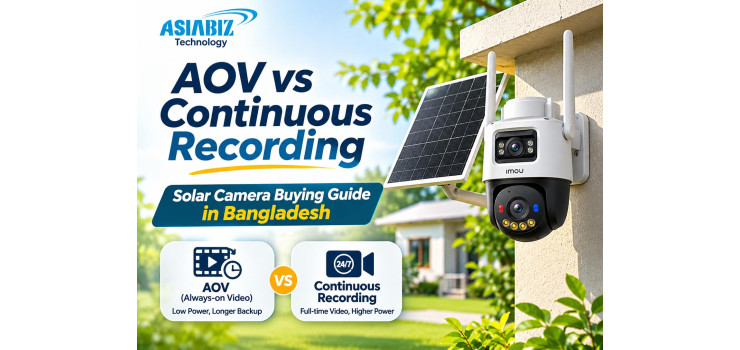
AOV vs Continuous Recording: Solar Camera Buying Questions in Bangladesh
Solar CCTV cameras are becoming an increasingly
practical security solution in Bangladesh, especially for homes, farms,
factories, warehouses, construction sites and remote properties where reliable
electricity or broadband internet may not be available.
However, before buying a solar security camera, one
important question deserves attention: Does the camera record continuously, or
only when motion is detected?
Many buyers see terms such as AOV recording, 24/7
recording, continuous recording and motion detection recording in camera
specifications. Although these terms sound similar, they can describe different
recording behaviours.
Understanding the difference is essential because
recording mode affects video coverage, battery consumption, storage requirements
and overall security performance.
In this guide, Asiabiz Technology explains how AOV
and traditional continuous recording work, their advantages and limitations,
and which recording system is more suitable for Bangladesh.
What Is AOV Recording in a Solar CCTV Camera?
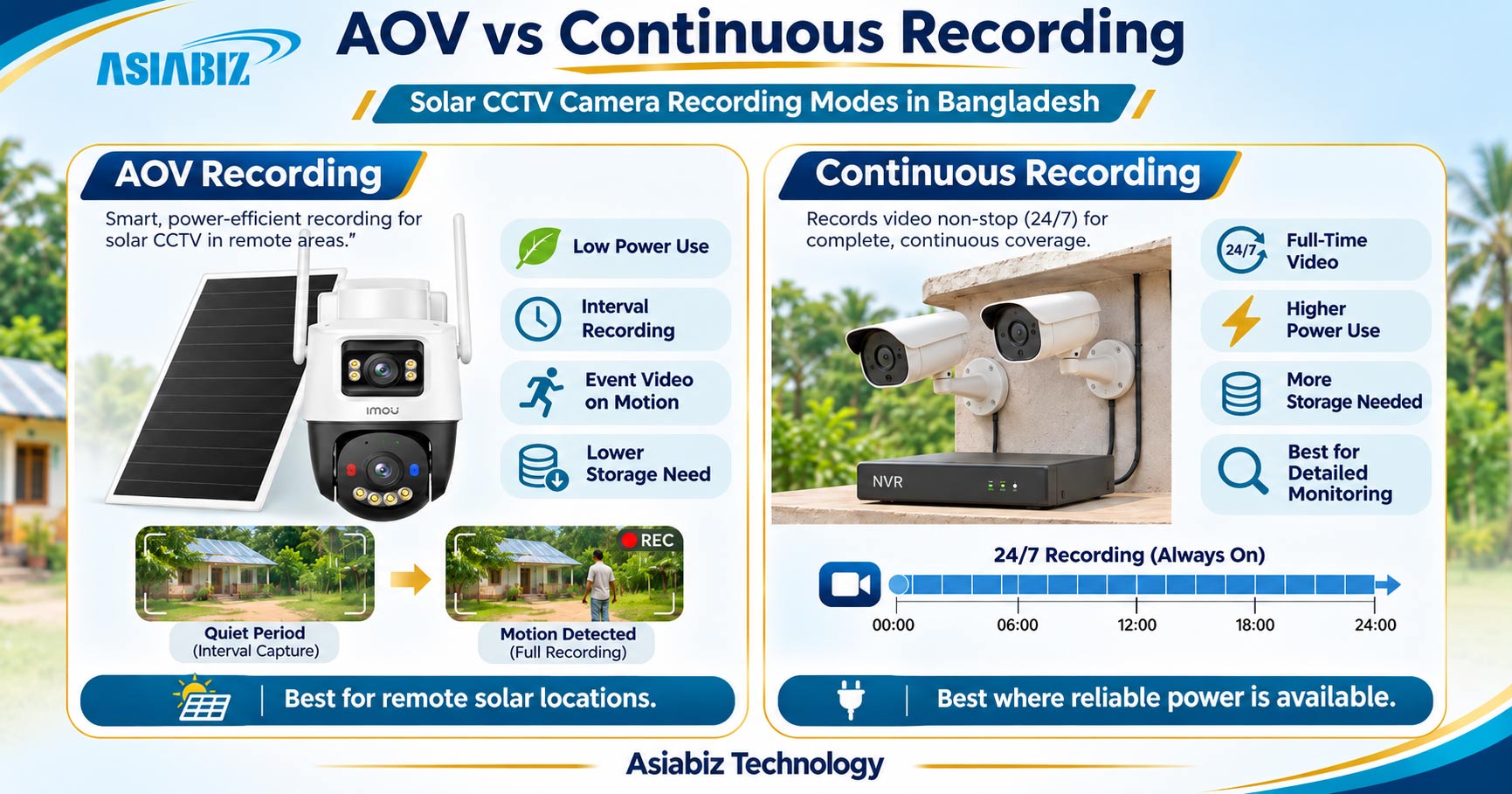
AOV stands for Always-on Video. It is a recording
technology designed to provide an extended visual record while reducing power
consumption compared with traditional full-frame continuous recording.
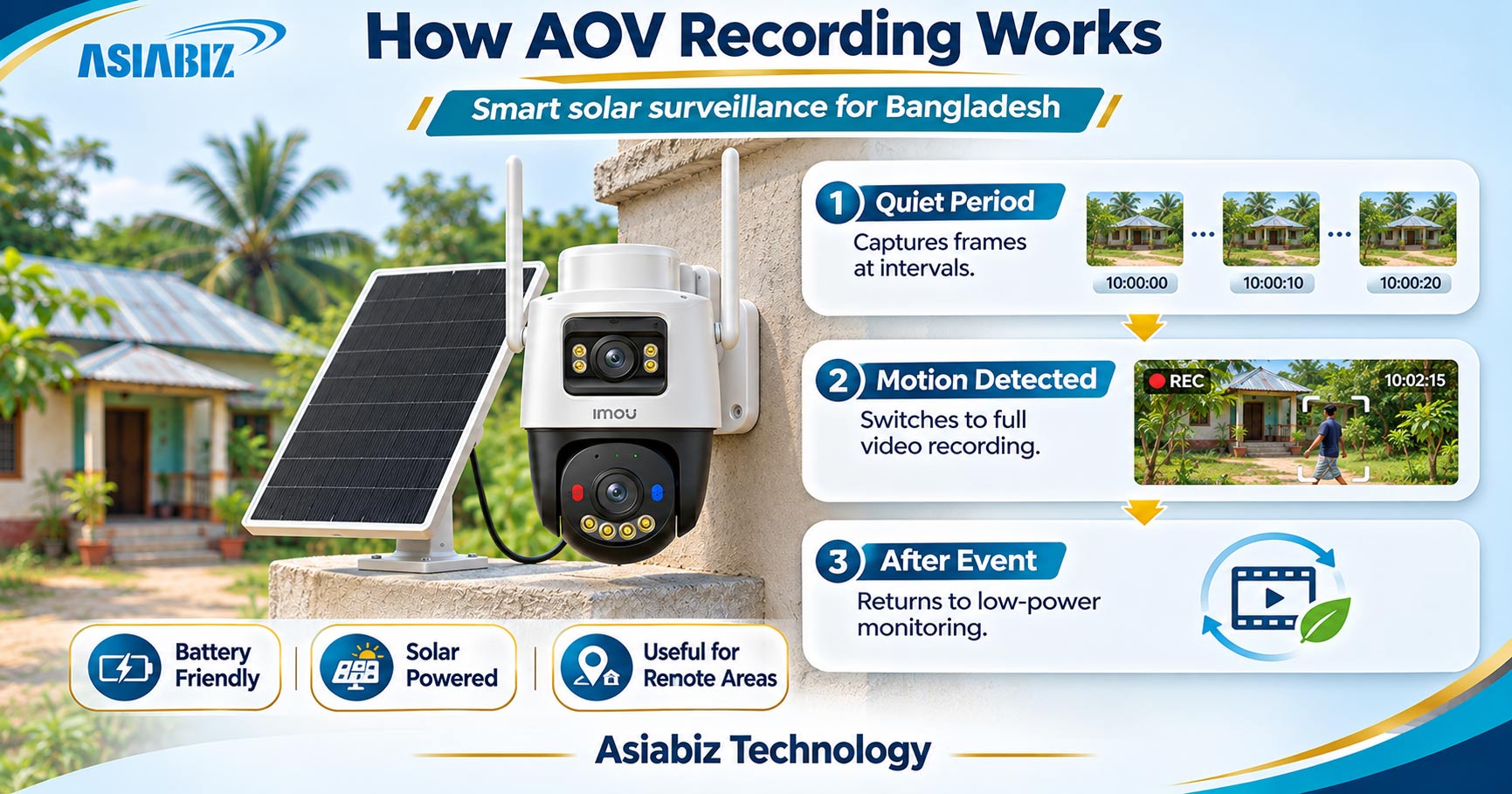
In supported AOV cameras, the device captures
images at regular intervals during periods without important activity. When a
person, vehicle or other configured event is detected, the camera switches to
normal video recording.
For example, the Imou AOV PT 5MP can capture one
frame every two seconds during quiet periods and switch to full-frame video
when an event is detected.
This approach combines two recording behaviours:
Interval-based recording: Captures periodic images during quiet periods to conserve battery and storage.
Event recording:
Records more detailed video when an important event triggers the camera.
The exact image interval, detection features and
recording behaviour depend on the specific camera model.
AOV is particularly useful for solar-powered CCTV
cameras because it reduces the energy required to maintain an extended
recording history.
How Does AOV Recording Work?
Imagine installing an AOV solar CCTV camera at the
entrance of a fish farm in Bangladesh.
During the afternoon, when nobody is entering or
leaving, the camera continues capturing periodic images instead of recording
full-frame video every second.
Later, when someone enters the monitored area, the
camera detects the activity and starts normal video recording according to its
settings.
After the event ends, it returns to its low-power
recording behaviour.
This creates a combination of time-lapse footage
and more detailed event recordings.
However, because the quiet periods are recorded at
intervals, AOV should not automatically be considered identical to full-frame
continuous recording.
What Is Continuous Recording in a CCTV Camera?
Continuous recording refers to a camera recording
video throughout the day and night rather than relying only on detected events.
Traditional 24/7 continuous CCTV recording
typically captures full-frame video at the configured frame rate, provided the
camera has sufficient power and storage.
For example, a wired IP camera connected to an NVR
may continuously record a shop entrance, warehouse or factory gate.
If someone walks through the area, the activity is
recorded as part of the existing video stream, whether or not motion detection
identifies the person.
This makes traditional continuous recording suitable
for security applications requiring a detailed, uninterrupted video history.
How Does Continuous Recording Work?
Suppose a warehouse owner wants to monitor workers,
delivery vehicles and visitors throughout the day.
A conventional continuous-recording CCTV system can
capture activity throughout operating hours and overnight.
Users can review the recording timeline to
investigate incidents, check delivery times or examine activities before and
after a particular event.
However, continuous full-frame recording generally
requires more electricity and storage than interval-based AOV recording under
comparable conditions.
For this reason, conventional wired CCTV systems
are often preferable where reliable electricity, suitable cabling and recording
equipment are available.
AOV vs Continuous Recording: Key Differences
The most important difference is how each system
records video when no significant event is occurring.
|
Features |
AOV
Recording |
Traditional
Continuous Recording |
|
Recording behaviour |
Periodic images plus event video |
Full-frame recording at configured settings |
|
Battery consumption |
Designed for lower consumption |
Generally higher consumption |
|
Solar camera suitability |
Particularly useful for battery-powered cameras |
Requires adequate continuous power |
|
Storage usage |
Often lower |
Generally higher |
|
Quiet-period footage |
Time-lapse or interval-based |
Detailed continuous video |
|
Motion detection |
Can trigger detailed event recording |
Not required to maintain recording |
|
Best applications |
Remote homes, farms, outdoor locations |
Shops, offices, warehouses, factories |
Important: Recording
technology varies across manufacturers. Some newer cameras offer additional
recording modes, so buyers should always review the specifications of the exact
model.
AOV vs Motion Detection Recording: Are They the Same?
No. AOV and motion-only recording are different.
A traditional motion-only battery camera may remain
in a low-power standby state until its sensors detect activity. It then records
a video clip and returns to standby.
This saves battery, but events may be missed if the
camera fails to trigger or if activity occurs outside the detection area.
An AOV camera can provide additional visual
information between detected events through its interval-based recording.
For example, suppose a vehicle stops outside a farm
gate but does not trigger an event recording.
A motion-only camera might have no footage of that
period. An AOV camera may retain periodic images that help establish when the
vehicle arrived.
However,
those images may not show every movement.
Therefore, AOV can provide more context than
motion-only recording, while conventional continuous recording remains the
stronger option when every moment of video is important.
Why Recording Mode Matters for Solar CCTV Cameras in Bangladesh
Solar security cameras normally depend on
rechargeable batteries and solar panels rather than permanent electricity
connections.
Their ability to operate depends on several
factors, including available sunlight, battery capacity, camera activity and
power consumption.
In Bangladesh, these considerations are especially
important during the monsoon season, when cloudy conditions and prolonged
rainfall can reduce solar charging.
1. Battery Life and Power Consumption
AOV recording helps conserve battery power by
reducing recording activity during quiet periods.
This can make it a useful choice for village homes,
fish farms, agricultural land and remote construction sites.
However, frequent motion events, prolonged live
viewing, night illumination and weak solar charging may increase battery
consumption.
Even when a camera is advertised as supporting
long-term solar operation, uninterrupted performance cannot be guaranteed in
every installation.
2. Solar Panel Charging Performance
A solar CCTV camera needs suitable sunlight to
replenish its battery.
If the solar panel is installed under a roof,
behind trees or in a heavily shaded area, charging performance may decrease.
Before installation, consider:
Daily direct sunlight exposure
Solar panel capacity and placement
Battery condition and charging requirements
Expected camera activity
Seasonal weather conditions
For installations in Bangladesh, properly
positioning the solar panel is as important as selecting the camera itself.
3. Recording Storage Requirements
Traditional continuous recording usually consumes
more storage because video is captured throughout the recording period.
AOV can reduce storage consumption by capturing
periodic images during quiet periods and detailed video during events.
However, actual storage usage depends on video
resolution, compression, frame rate, recording duration and activity frequency.
Before purchasing a memory card, check the camera's
maximum supported capacity and recording settings.
4. Internet and 4G Data Usage
Many buyers assume that a 4G solar camera
continuously uploads all recorded footage using mobile data.
That is not necessarily true.
On supported models, recordings can be saved
locally to a microSD card. Mobile data is then used for functions such as
remote viewing, notifications and accessing footage through the internet.
However, specific cloud features may require additional
data or subscriptions.
For remote locations in Bangladesh, check SIM
compatibility, mobile signal strength and expected data consumption before
installation.
Can an AOV Solar Camera Really Record 24/7?
Yes, supported AOV cameras can maintain an
around-the-clock recording history, but this does not necessarily mean
full-frame video is recorded every second.
For example, the Imou AOV PT 5MP uses time-lapse
recording during quiet periods and switches to more detailed video during
detected events.
The recording timeline can therefore cover the day
without capturing full-frame continuous footage throughout every quiet period.
This distinction matters when choosing a camera for
evidence collection.
If you need detailed footage of every movement,
conventional continuous recording may be more suitable.
If you primarily need extended outdoor monitoring
with lower battery consumption, AOV can offer a practical balance.
Is AOV Recording Better for Home Security?
For many Bangladesh households, AOV solar cameras
offer a convenient solution, particularly where running electrical cables is
difficult.
An AOV camera can monitor a gate, driveway, rooftop
or surrounding outdoor area while helping conserve battery power.
Smart detection features can also notify homeowners
when relevant activity occurs.
However, buyers should consider camera placement,
detection distance, night vision and available sunlight.
For homes where power and network connections are
already available, a wired continuous-recording CCTV system may provide more
comprehensive footage.
The better choice depends on whether convenience,
battery efficiency or uninterrupted video detail is the main priority.
Which Recording Mode Is Best for Farms, Factories and Warehouses?
Different environments require different
surveillance approaches.
Fish Farms and Agricultural Land
AOV solar cameras are useful for fish farms, crop
fields and other locations where electricity and broadband connectivity are
limited.
A compatible 4G camera allows owners to monitor
selected areas remotely without installing extensive wiring.
Village Homes and Remote Properties
A solar-powered AOV camera can provide practical
monitoring for village houses, empty properties and isolated entrances.
Its battery-powered design can reduce dependence on
grid electricity, although charging and network conditions still matter.
Shops, Factories and Warehouses
For locations where recording every moment is
essential, conventional continuous-recording CCTV systems are often the better primary
solution.
These systems can support detailed investigation of
worker activities, deliveries and incidents.
AOV solar cameras can still serve as supplementary
cameras at remote gates, boundaries or outdoor storage areas.
Imou AOV Solar Cameras: A Practical Option in Bangladesh
Imou offers solar-compatible camera models featuring
Always-on Video technology for outdoor monitoring.
The Imou AOV PT 5MP Solar System 4G & WiFi
Camera is an example of a model designed to combine AOV recording, wireless connectivity
and solar charging.
Its recording technology is especially relevant for
installations where permanent electrical wiring is difficult.
Another option is the Imou AOV Dual
IPC-SA70F-10M0T2-EU 10MP Dual Lens Solar System 4G & WiFi Camera, which
combines two 5MP camera views, solar charging support and AOV recording
capability.
Dual-lens systems can be useful when monitoring
both a fixed priority area and another direction from the same installation
point.
Before choosing either model, confirm its exact
recording modes, storage support, solar panel package, compatible networks and
warranty details.
For a broader introduction to selecting a
solar-powered surveillance system, read our Best Solar 4G CCTV Camera in Bangladesh Buying Guide.
Important Questions to Ask Before Buying an AOV Solar Camera
Before buying a solar CCTV camera in Bangladesh,
consider these questions.
Does the camera support AOV, motion-only or full-frame
continuous recording?
Check the exact recording technology instead of
relying only on a 24/7 marketing claim.
How much sunlight does the installation location
receive?
Insufficient charging can affect operation, particularly
during cloudy weather.
Does the camera support local storage?
Confirm compatible microSD capacity, overwrite
behaviour and any cloud-storage requirements.
Will the camera work with the available internet
connection?
For 4G cameras, check supported SIM networks and
signal quality.
Is the camera suitable for outdoor conditions?
Review weather protection, mounting position,
operating temperature and night-vision performance.
Does the camera provide suitable event detection?
Check detection accuracy, coverage, notifications
and available sensitivity settings.
Asking these questions helps buyers choose a
surveillance system based on actual security requirements instead of marketing
claims.
Where to Buy AOV Solar CCTV Cameras in Bangladesh
If you are looking for an AOV solar CCTV camera in
Bangladesh, Asiabiz Technology offers security camera solutions for
residential, commercial and outdoor applications.
Customers can explore Imou cameras, solar-powered
security systems, WiFi cameras, 4G cameras and conventional CCTV recording
solutions.
You can compare recording capabilities and product
specifications before choosing a suitable model.
Explore the Imou AOV Dual 10MP Solar 4G & WiFi Camera or visit Asiabiz Technology for available products and current pricing.
For product guidance, you can also visit the
Asiabiz Technology showroom at ECS Computer City (Multiplan Center), New
Elephant Road, Dhaka.
Frequently Asked Questions (FAQs)
Q: Is AOV the same as 24/7 continuous recording?
A: Not
necessarily. AOV maintains an extended recording history using low-power
techniques such as interval-based capture and event video. Traditional
continuous recording generally captures full-frame video throughout the
configured recording period.
Q: Does an AOV camera record without motion?
A: Yes.
Supported AOV cameras can capture periodic images during periods without
detected events. The interval depends on the camera model and settings.
Q: Can a solar CCTV camera work at night?
A: Yes.
Solar security cameras generally use stored battery energy to operate at night.
Nighttime performance depends on battery charge, camera settings and hardware
capabilities.
Q: Which is better: AOV or motion detection?
A: AOV
can provide additional footage between detected events, while motion-only
recording generally focuses on triggered clips and conserving power. The better
option depends on security requirements and available power.
Q: Does an AOV solar camera need WiFi?
A: Not
always. Some AOV solar cameras support 4G SIM connectivity, allowing remote
access without broadband WiFi. Network compatibility must be verified for the
selected model.
Q: Can an AOV solar camera record without internet?
A: Supported
models may continue recording to local storage without an active internet
connection. Remote live viewing, alerts and cloud features may be unavailable
until connectivity returns.
Q: What is the best solar CCTV recording mode in Bangladesh?
A: AOV
can be suitable for battery-powered monitoring of homes, farms and remote
locations. Traditional full-frame continuous recording is generally preferable
for installations requiring detailed uninterrupted footage.
Final Verdict: AOV vs Continuous Recording — Which Should You Choose?
Both AOV and continuous recording can provide
valuable security, but they serve different requirements.
Choose AOV recording when you need a solar-powered
camera that balances extended monitoring with lower battery and storage
consumption.
Choose traditional continuous recording when you require detailed video throughout the day and have sufficient electricity and recording capacity.
For homes, farms, warehouses and remote properties
in Bangladesh, the ideal choice depends on location, sunlight availability,
internet connectivity, recording requirements and budget.
Before purchasing, compare the recording
capabilities of the exact camera model rather than assuming that every camera
advertised as 24/7 recording works in the same way.
With the right setup, a well-selected security camera can provide more reliable monitoring and help protect the people and property that matter most.


Comments
There are no comments for this Article.