
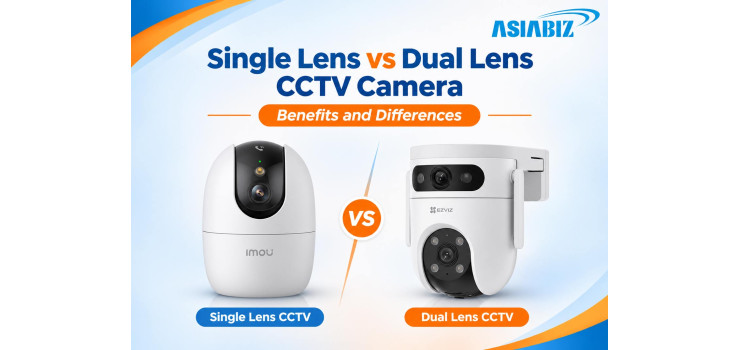
Single Lens vs Dual Lens CCTV Camera: Benefits and Differences in Bangladesh
Choosing a security camera involves more than megapixels. An apartment
entrance may need one view, while a shop or parking area may need two.
This is where the single lens vs dual lens CCTV camera comparison
matters. Is a dual-lens camera worth paying more for, or will a good
single-lens camera do the job?
Compare coverage, image quality, installation, storage, and costs in
Bangladesh.
Quick Answer: Single Lens or Dual Lens?
Choose a single-lens CCTV camera when one well-positioned view covers
the area you need. Choose a dual-lens camera when you want to monitor two
directions simultaneously, such as a gate and driveway, or keep a wide overview
while a second lens tracks movement.
Dual lenses may reduce blind spots but cannot replace two cameras
everywhere.
What Is a Single-Lens CCTV Camera?
A single-lens camera uses one optical lens and image sensor to capture
a scene. It may be a fixed bullet or dome camera, or a motorized pan-and-tilt
(PT) WiFi camera.
Fixed models watch one direction; PT models rotate but show only their
current direction.
Advantages of Single-Lens Cameras
Often more affordable and straightforward to set up.
One video view is easy to manage and review.
Available in indoor, outdoor, WiFi, PoE, and other configurations.
higher-quality lens and sensor can provide excellent details in one
important zone.
Limitations
A single fixed view may miss a second entrance. A single PT camera can
scan different places, but when it turns to follow a visitor, it may no longer
show its previous direction. Coverage depends on placement and viewing angle.
What Is a Dual-Lens CCTV Camera?
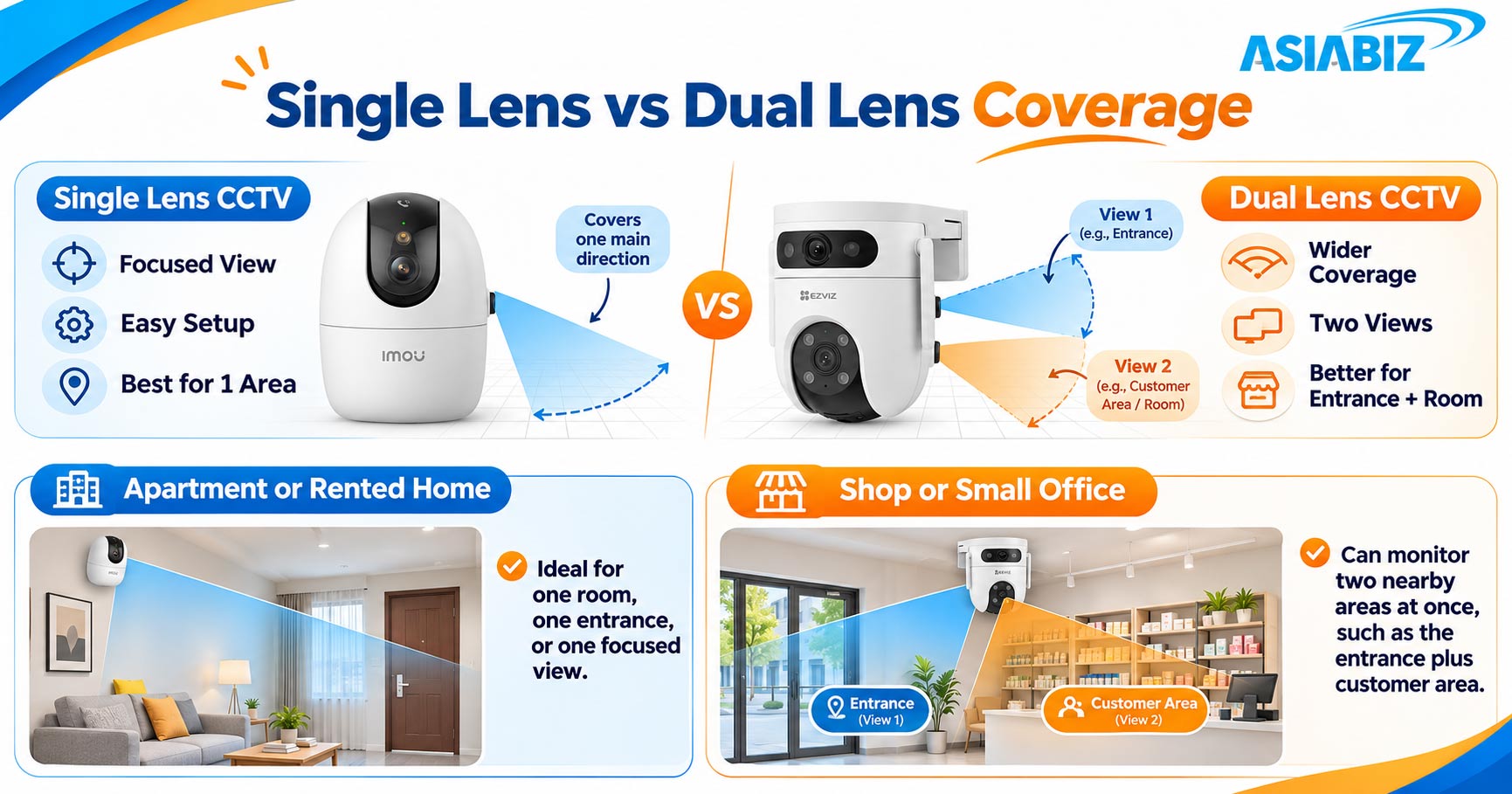
A dual-lens CCTV camera contains two lenses that observe different
views or work together for a wider surveillance task. Designs vary
considerably.
Fixed Lens + Pan-and-Tilt Lens
One lens maintains an overview while a movable lens checks another area.
For example, the upper lens may monitor a shop entrance while the lower lens
follows activity near parked motorcycles.
Wide-Angle + Telephoto Lens
Some models pair wide and narrow views for simultaneous context and
detail; not all offer optical zoom.
Panoramic Dual-Lens Design
Other products combine two views into a broader panorama. Dual lens
does not automatically mean 360-degree coverage; check actual viewing angles
Single Lens vs Dual Lens Camera: Comparison Table
|
Feature |
Single-Lens
Camera |
Dual-Lens
Camera |
|
Lenses and views |
One lens, normally one view at a time |
Two views or combined view, model-dependent |
|
Coverage |
Focused on one area |
Can cover two areas from one mounting point |
|
Tracking |
PT models may track by turning one lens |
Selected models track while another lens keeps an overview |
|
Image quality |
Depends on each sensor and lens |
Depends on both sensors and lenses separately |
|
Installation |
Typically simpler |
Needs careful positioning for both views |
|
Recording |
Usually one main video stream |
May create two streams or a combined feed |
|
Storage/network use |
Based on one stream |
Can be higher when recording both streams |
|
Price |
Often lower upfront |
Often higher upfront |
|
Best use |
One door, corridor, room or checkou |
Gate plus driveway, shop plus forecourt, wider outdoor spaces |
Key point: A 6MP dual-lens
camera marketed as 3MP + 3MP contains two 3MP views. It does not produce the
same single-frame detail as a genuine 6MP sensor. Likewise, 10MP (5MP + 5MP)
means two 5MP views unless a manufacturer specifies a different imaging method.
6 Practical Benefits and Trade-Offs
1. Wider Coverage and Fewer Blind Spots
Dual lenses may cover a gate and parking area. A single wide-angle lens
can also cover both, but distant subjects may appear smaller. Compare actual
angles.
2. Tracking Without Losing the Main View
In compatible fixed-plus-PT models, the fixed lens continues watching
one zone while the motorized lens follows movement. This is useful for
entrances with people and vehicles coming from several directions. Check
whether both lenses provide simultaneous live views and whether co-detection is
supported.
3. Detail, Resolution, and Digital Zoom
Two lenses do not automatically mean a sharper face or license plate.
Detail depends on sensor resolution per lens, focal length, lighting, shutter
speed, and subject distance. Digital zoom enlarges recorded pixels; it cannot
create details missing from the source image.
4. Night Vision Performance
Single- and dual-lens cameras may offer infrared or color night vision.
In dual-lens designs, each lens can have different illumination and viewing
distances. Check night-vision specifications for both views. If accurate
vehicle colors matter, test footage under the actual lighting conditions.
5. Recording, Storage, and Internet Use
Two streams may use more storage and bandwidth, depending on
compression and recording settings. Confirm whether playback is split-screen or
separate, and whether the NVR supports both feeds.
6. Purchase and Installation Cost
A single-lens camera is often the economical choice for one doorway.
Dual-lens models may reduce the need for a second camera or a second mounting
point, but not always. Compare complete costs: cameras, power supply, cabling,
storage, network equipment, and installation labour in Bangladesh.
Which Camera Is Better for Your Property in Bangladesh?
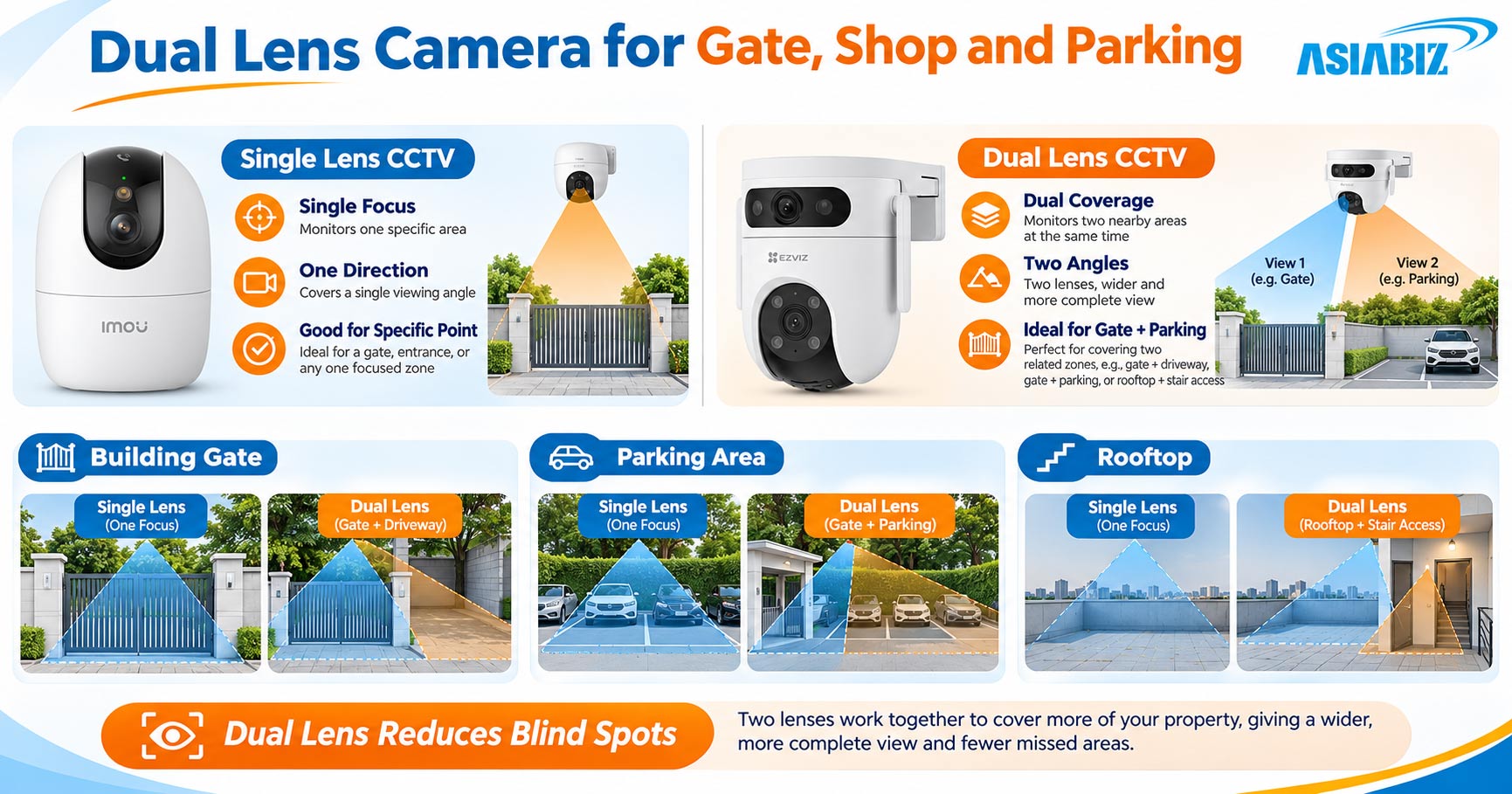
Apartment or Rented Home
For one living room, child's room, or apartment entrance, a single-lens
indoor PT camera is usually sufficient. It is compact and easy to reposition.
Consider dual-lens coverage only if two important areas must remain visible at
once.
Shop or Small Office
A single camera aimed at the cash counter can provide a focused record.
For a shop entrance and customer area, dual-lens coverage may be useful—but
separate cameras can be better when the areas are far apart.
Building Gate, Parking Area, and Rooftop
A dual-lens outdoor camera can maintain a gate overview while checking
the driveway or rooftop access. Avoid glare and obstructions; opposite building
sides may still need separate cameras.
Fish Farm, Warehouse, or Large Compound
A dual-lens model may be helpful where two nearby zones share a
mounting point. For widely separated locations, plan multiple cameras, suitable
power, reliable connectivity, and backup recording. Lens count alone cannot solve
network or power problems.
Recommended Single- and Dual-Lens Cameras at Asiabiz
These examples show different camera designs; confirm current price,
stock, and model specifications before purchasing.
Imou Ranger 2 Pro 5MP — Single-Lens Indoor WiFi
The 5MP provides a single 5MP
view with motorized pan-and-tilt, two-way audio, and smart detection. It is
suitable for rooms, small offices, and indoor entrances where one rotating view
is enough.
Imou Cruiser Dual 2 6MP — Dual-Lens Outdoor WiFi
The Imou Cruiser Dual 2 6MP combines a 3MP fixed lens and a 3MP pan-and-tilt
lens. This arrangement is useful for simultaneously watching a gate and another
nearby area, with outdoor-oriented smart monitoring features.
EZVIZ H9c 6MP — Dual-Lens Outdoor WiFi
The offers two 3MP views, with a
wide upper lens and a motorized lower lens. It is worth considering for wider
entrances, courtyards, and small business exteriors where linked detection and
tracking may help.
For more options, explore Asiabiz WiFi Cameras and our guide to WiFi vsWired CCTV Cameras.
5 Things to Check Before Buying
Coverage map: Sketch the
entrance, parking area, and blind spots. Decide whether one mounting point can
actually see both zones.
Resolution per lens: Read
the detailed specifications, not only the combined megapixel number.
Recording support: Verify
whether both views record to microSD, a compatible NVR, or cloud storage.
Connectivity and power: Check
WiFi strength, PoE or adapter requirements, and UPS needs during load shedding.
Night samples and weather
rating: Compare actual low-light footage, warranty, and outdoor protection
for the exact model.
Frequently Asked Questions
Q: Is a dual-lens CCTV camera better than a single-lens camera?
A: Not always. Dual lenses
can monitor two areas at once, while a good single-lens model may deliver
better value and image quality for one focused location.
Q: Does a 6MP dual-lens camera have two 6MP lenses?
A: Not necessarily. A model
advertised as 6MP (3MP + 3MP) has two 3MP views. Always check the resolution of
each sensor.
Q: Can a dual-lens camera replace two CCTV cameras?
A: Sometimes, when both
desired views are visible from one mounting point. Separate cameras may work
better for distant areas, opposite directions, or different mounting heights.
Q: Do dual-lens cameras need more internet data?
A: They may use more
bandwidth when both video streams are transmitted. Actual consumption depends
on bitrate, compression, live viewing, and recording settings.
Q: Can dual-lens WiFi cameras record to an NVR?
A: Some can connect to
compatible NVR systems. Confirm whether the recorder supports both lens feeds,
the necessary protocol, and the chosen recording mode.
Q: Which is cheaper in Bangladesh?
A: Single-lens cameras
generally cost less individually. Compare the complete installed cost when a
dual-lens camera might replace two separate cameras.
Final Verdict: Which CCTV Camera Should You Buy?
Choose single lens for a clear, specific view at a simpler cost. Choose
dual lens when simultaneous coverage of two nearby areas, wide-plus-detail
viewing, or smarter coordinated tracking is useful.
The right decision depends more on camera placement and what you need to see than on the number of lenses. Compare suitable models at Asiabiz Technology before buying.


Comments
There are no comments for this Article.